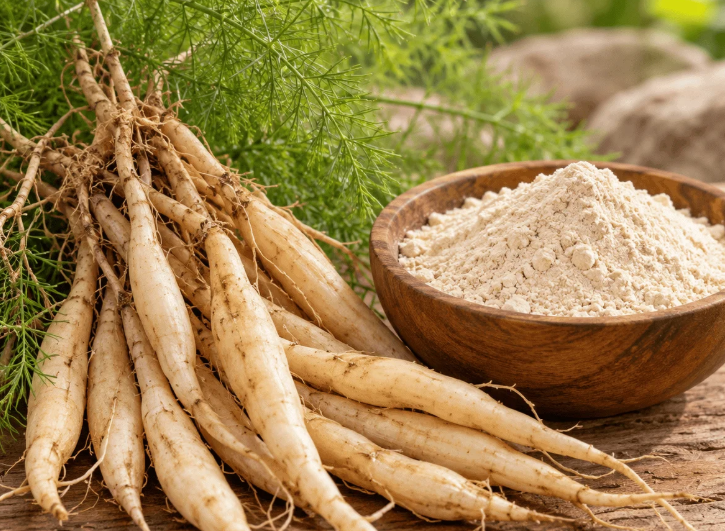
Most buyers meet this ingredient as a light brown powder in a lined drum, long after anyone has handled the actual plant. By then, a dozen small decisions about digging, peeling, drying and extraction have already shaped what sits in that drum. Each one leaves a mark on colour, moisture and saponin content. If Asparagus Root Extract is on your raw material list, those early steps deserve as much attention as the final certificate.
The plant behind it is Asparagus racemosus, better known as Shatavari, not the garden asparagus on a dinner plate. Asparagus Root Extract comes from its fleshy roots, which pass through a farm, workshop and extraction plant before reaching you. So what actually happens along the way, and which steps quietly decide quality?
Growing the Shatavari Tuberous Roots
Shatavari is a climbing, spiny under-shrub that stores its value in tuberous roots underground. Fresh roots look fleshy and spindle-shaped, with light ash skin and white flesh. As they dry, they develop long wrinkles.
Timing starts to matter early. India’s agro-technique guidance puts crop maturity at about 12 months after planting. Growers who want seed also wait about 20 months.
The season matters too. November and December are considered the best months to harvest, once the above-ground parts turn pale yellow. Perhaps that sounds like farm trivia. It affects how a root dries and how it holds up later, so it isn’t.
Harvesting and Peeling Asparagus Racemosus Roots
Start in the field. Digging out whole roots without breaking them takes care, and peeling takes even more effort. A 2019 study estimated that harvest and post-harvest work, mostly peeling, accounts for roughly 60 to 80% of cultivation cost.
That cost pressure explains a lot. When a step eats most of the budget, some suppliers will be tempted to rush it.
Growers use a few different routes to remove the thin outer skin:
- Soaking the roots in lukewarm water for about an hour to soften the covering, then peeling by hand
- Boiling the roots at 100°C for 35 minutes before peeling, which the 2019 study rated as the best method
- Peeling right after boiling, which some growers prefer because the skin comes away more easily
Boiling changes the material visibly. Boiled tubers turn yellowish and fetch a higher market price. That colour shift matters if a powder looks different from your approved sample.
Drying Shatavari Roots Without Losing Saponins
After peeling comes drying; one government guide suggests four to five hours in shade, followed by oven drying at 40°C for 20 minutes or longer, depending on moisture. Growers judge dryness: a fully dry tuber snaps with a cracking sound.
Here is where the real risk sits. The main active saponins in these tubers are highly hygroscopic, meaning they pull moisture from the air.
A study published in Acta Horticulturae tracked root powder for 12 months. After one year, average saponin loss reached 43.9% for oven-dried powder and 48.3% for sun-dried powder. Airtight bags held losses to 41.4%, while open bags lost 50.8%.
Even the best combination, oven drying with airtight packing, still lost 39.5% of its saponin content. The authors linked part of this loss to moisture. So how old was the root powder in your last batch?
How Extraction Turns Shatavari Powder Into Asparagus Root Extract
Then comes the part most buyers never see. Dried roots get ground, and that powder goes into an extraction vessel.
Solvent choice changes the result. One lab study made an aqueous decoction, then concentrated it in a rotary evaporator at 50°C. The output was a pale brown, gummy extract, which tells you how sticky this material can get before drying.
The chemistry is not simple either. Shatavari root holds a mix of saponins with different polarities, and separating them remains difficult. In one isolation study, Shatavarin IV lost purity and yield at temperatures above about 17 to 22°C during column chromatography.
See Also: Comics Without the Blank Page: How an AI Comic Assistant Shapes Story, Character and Scene
That finding comes from a lab purification setup, not commercial extraction, so it shouldn’t be stretched too far. It does suggest that heat during processing is worth asking about, though.
Testing Shatavarin IV in the Finished Powder
Labs often use Shatavarin IV as a marker compound. A 2019 study quantified it in root extracts with UHPLC and built a calibration curve against a reference standard.
A marker figure is only useful when you know three things:
- Which compound the lab measured, Shatavarin IV or total saponins
- Which method produced the number, such as UHPLC, HPLC or a gravimetric assay
- How old the root material was when extraction started
A supplier who can’t answer the third question may not track it. That may be fine for some products. For a saponin-standardised extract, it probably isn’t.
Working With an Uttarakhand Botanical Extract Manufacturer
ShriNanda Herbs manufactures herbal extracts, conventional powders and phytochemicals in Uttarakhand, and runs an in-house testing facility that checks its extracts for purity and potency.
If you’re mapping out a root-based botanical ingredient, share your processing and testing requirements with the team to discuss what they can support.